I don't use my blog as much as I used to due to lack of time and something to say that I don't say through other avenues. But something happened today that made me stop and think that perhaps I could use this blog for a more personal posting than usual.
I've always thought that life is precious and yet we often take it for granted, typically until the last moment. We make a big show of people being born because whatever your faith or beliefs, seeing a new life born into the world is a wonderful thing! Death is often more dour and a more personal thing. Typically unless someone we knew died, we all only hear about the deaths of celebrities, many of whom probably had little or no impact on our own lives.
Death is a sad enough occasion at the best of times. Again depending upon your faith or belief system it probably is the last time that unique individual will set foot on this planet and mingle with people here. Some aspects of what made them human, such as the raw materials, will eventually find their way back into the environment and, just as we're all made of "star stuff", back into other people in one way or another. But their uniqueness, their individuality, is gone forever - as best we can tell. That is sad. At it's rawest, this is a loss of information that can never be retrieved. A loss of memories, experiences etc. that helped to make the person who they were.
We often hear statements like "they're not dead as long as we remember them". Thinking about the sentiment behind these kinds of statements it makes sense. And we can all probably know someone who died, family or celebrity, that we remember fondly. But what of those people who have no one? That's the biggest loss of all: there's no one to remember them, to remember what made them unique within the 7 billion people on the planet. Maybe they weren't celebrities. Maybe they weren't world leaders or people who went down in the history books. But they were people nonetheless and to not be remembered is like them falling into a black hole, where no trace remains.
If you've gotten this far then you may be wondering why I'm writing this. I live with my family in an area of the country that means we have only 2 neighbouring houses. Both houses have people in them who have lived there for over 7 decades (we've been here for 14 years). Today one of those people, John Hudspith, died. He was 80 and a kind, quietly spoken gentleman; a man of his era. But he was alone. No family left alive. Few friends, other than ourselves and the other neighbours; none really close. Even then he was a private person. And it struck me that in his death he would be forgotten because he lacked celebrity status or family or history-worthiness. Well this is my small attempt to give him a little immortality, because if you've read here then you've paused for a moment to wonder about this John Hudspith, who he was and why I would want to remember him. Thank you.
Monday, October 27, 2014

Tuesday, October 14, 2014
Encrypting Data?
I read that the FBI doesn't want Google or Apple to encrypt data on phones by default. Their reasoning is that it makes it harder for them to track evil doers. I do understand their concerns but I don't believe in their solution: no encryption, or give them keys to decrypt. It's not that I distrust the police or security forces or believe criminals should be able to get away with their crimes, but if my data can be decrypted by one group then there's a good chance it can be decrypted by others (backdoors can and will be exploited). I don't encrypt my data to hide it from the law; I encrypt it to stop it getting into the hands of criminals and people who could use it against me or others! And if we're not allowed to encrypt phones then what's next? Laptops? Cloud?
Unencrypted data may make their job easier, but surely they do detective work too? Just imagine if the FBIs approach had been enabled decades or even centuries ago. Letters couldn't go into envelopes or envelopes could be opened at any time (probably happened/happens today anyway); it would be illegal to write in anything other than plain English or natural languages (no codes); presumable all of your data would be easily accessible (no bank vaults, or their codes would have to be available to the police without a warrant!) The latest Sherlock Holmes stories would be very mundane as he'd just need to access the criminals' documents to discover their evil plans.
The reality is that encryption of data, hiding of that data, has always happened. Whether it's Sherlock Holmes story The Adventure of the Dancing Men, the Germans during WW2, the Romans, there are countless examples of coded information being used for one reason or another. And good detective work, aided by people in the field, has always been at the heart of the solutions. I don't want criminals to have access to my data and if that means the police need to do a bit more work then so be it.
Unencrypted data may make their job easier, but surely they do detective work too? Just imagine if the FBIs approach had been enabled decades or even centuries ago. Letters couldn't go into envelopes or envelopes could be opened at any time (probably happened/happens today anyway); it would be illegal to write in anything other than plain English or natural languages (no codes); presumable all of your data would be easily accessible (no bank vaults, or their codes would have to be available to the police without a warrant!) The latest Sherlock Holmes stories would be very mundane as he'd just need to access the criminals' documents to discover their evil plans.
The reality is that encryption of data, hiding of that data, has always happened. Whether it's Sherlock Holmes story The Adventure of the Dancing Men, the Germans during WW2, the Romans, there are countless examples of coded information being used for one reason or another. And good detective work, aided by people in the field, has always been at the heart of the solutions. I don't want criminals to have access to my data and if that means the police need to do a bit more work then so be it.
Monday, May 26, 2014
Microservices and transactions - turning back the clock?!
A cross-post of an entry I wrote for the JBossTS/Narayana blog. Microservices and transactions, oh my!
Thursday, May 08, 2014
Microservices Architecture
I wrote a piece on InfoQ a while back on Microservices and SOA. While researching for the article and afterwards, I was struck by something else I wrote almost 8 years ago around SOA 2.0. I've got to say that I see a lot of similarities: people trying to come up with new terms for something that already exists and which really doesn't need to be redefined just better understood! Please, no Microservices. Let's stick with SOA!
Sunday, April 27, 2014
The future adaptive middleware platform
Back in the 1990's, way before the success of Java let alone the advent of Cloud, there was a lot of research in the area of configurable and adaptable distributed systems. There was even a conference, the IEEE Conference on Configurable Distributed Systems. Some of the earliest work on distributed agents, adaptable mobile systems and weak consistency happened here and I'm glad to have been a part of that effort. However, two decades ago the kinds of environments that we envisioned were really just the thing of blue-sky research. Times change though and I believe that a lot of what we did back then, and research that has happened in the intervening years, is now much more applicable and in fact necessary for the kind of middleware platform that we need today.
For a start one of the aims of some of the research we did was environments that could self manage, monitor themselves and adapt to change, whether due to failures in network topology and machines, or changes in application (user) requirements. These were systems that we believed would need to be deployed for long periods of time with little or no human intervention. Precisely the kinds of environments that we are considering today for Cloud and IoT: reducing the number of system administrators needed to manage your applications is a key aim for the Cloud, and imagine if you had to keep logging in to your smart sensors every time the wifi went down or a new device was added to the network.
There's a lot that can change within a distributed system and much of it inadvertent or unknowable a priori. This includes failures of the network (partitions, overloading) and the nodes (crash failures or overloading making the machine so slow that it appears to have crashed). Machines being added to the environment may mean that it's more efficient to migrate entire applications or components (services) to these new arrivals to maintain desired SLAs, such as performance or reliability. Likewise a machine may become so overloaded that it's simply impossible to maintain an SLA and so migration off it elsewhere may be necessary. Traditional monitoring and management approaches would work here but tend to be far too manual. This tends to mean that whilst problems (faults) can be tolerated, the negative impact on clients and applications, such as downtime, can be too much.
The middleware should be able to detect these kinds of problems or inabilities to match SLAs, or even predict that these SLA conflicts are going to occur (Bayesian Inference Networks are good for this). It may seem like a relatively simple (or subtle) addition to monitoring and management (or governance) but it's crucial. Adding this capability doesn't just make the middleware infrastructure from being a little more useful and capable, it elevates it to an entirely different level. The infrastructure needs to have SLAs and QoS built in from the start for components as well as higher level services. JON-like in monitoring and managing the surroundings as well as itself.
Each component needs to potentially be driven through a smart proxy so that things can be dynamically switched from local to remote implementations. Maybe environment specific component implementations if existing ones cannot fit or be tuned to fit, e.g., a component written in C for embedded environments where the JVM cannot run due to space limitations. It also needs to add in something like stub-scion pairs (Shapiro in the 80's or Caughey with Shadows in the 90's) to allow for object migration with dependency tracking and migration. Also add in disconnected operation work from the 80's and 90's: yes, the network has improved a lot over the years but disconnection is more likely now because we are used to being connected so much.
We need new frameworks and models for building applications, though current approaches should work. Being transparent is best, but opaque allows for using existing applications. Each component needs something that implements a reconfigure/adapt interface. Listens on a bus for these events. Adapt based on available memory, processor changes such as speed or number, network characteristics, disconnection, load on processor, dependency on other components, etc. Include the dispatcher architecture to help adaptation at various levels throughout the invocation stack.
OK so let's summarise the features/capabilities and add a few things that are implicit:
- Can adapt to changes in environment. Autonomous monitoring and management.
- All components can have contracts and SLA.
- Event oriented backbone/backplane/bus.
- Asynchronous interactions. Synchronous on top if necessary.
- Flexible threading model.
- Core low overhead and footprint. Assumed to be everywhere and all applications or services plug into it. So much of these other capabilities would be dynamically added when/if needed, such that the core needs to know how to do very little initially.
- Repository of components with social-like tagging for contract selection.
- Native language components ranging from thin client through to entire stack.
- DNA/RNA-like configuration to allow for recovery in the event of catastrophic failure or to support complete or partial migration to new (blank/empty) hardware.
- Self healing.
- Tracking of dependencies between objects or services so that if the migration of an object/service is necessary (e.g., due to a node failure or being powered down), all related services/objects can be migrated as well to ensure continued operation.
So this is it in a (relative) nutshell. The links I've included throughout should help to give more details. If I get the time I may expand on some of these topics in future entries. Even better, maybe I'll also get a chance to present on one or more of these items at a conference or workshop. One of the problems I have with my job is that there's so much to do and so little time. Whilst all of this is wrapped up inside my head, the time to write it down doesn't come in a block large enough to do it justice in one sitting. Rather than spend months writing it up, I wanted to take a good open source approach and "release early, release often". Consider this a milestone or beta release.
Sunday, April 13, 2014
Rush and Senna
This is going to seem like a strange entry but I wanted to record it if only for myself. When I was growing up I was a serious Formula One fan and two events remain in my mind as defining moments of enjoying the sport. The first was James Hunt winning the F1 Championship (and Niki Lauda’s accident), and the second was the death of Ayrton Senna. I wasn’t watching the former live, but saw it on repeats (TV was much more limited in those days, so live feeds were few and far between). The latter I was watching with friends as it happened and can still remember where I was to this day - in the dorms at university, having just eaten lunch! There was excitement, risk and sadness in equal measure for each event and yet over the years they dwindled in my mind as other things, such as real life, took hold and dragged me through the present and into the future.
That was until I watched the movies Senna and Rush over the course of the last couple of years. Both of these movies are very different beasts and yet both of them excel in brining to the watcher that sense of what is was like being there at the time. As someone who was there at the time and someone who watches F1 today when I have time, they also illustrate what I think the sport misses these days: excitement and challenges (ok, the risk is a big element here). If you’re at all interested in Formula One then check out either or both of these films!
That was until I watched the movies Senna and Rush over the course of the last couple of years. Both of these movies are very different beasts and yet both of them excel in brining to the watcher that sense of what is was like being there at the time. As someone who was there at the time and someone who watches F1 today when I have time, they also illustrate what I think the sport misses these days: excitement and challenges (ok, the risk is a big element here). If you’re at all interested in Formula One then check out either or both of these films!
Wednesday, April 09, 2014
Speaking at Dynamo14
I'm going to be speaking at the Dynamo14 conference in a few weeks time. I'll be hot off a plane from Boston to be interviewed by the BBCs Rory Cellan-Jones! Looking forward to it, though I hope I'm not too jet lagged!
Wednesday, April 02, 2014
Another "I told you so" moment
I mentioned earlier about how most cloud providers had agreed that there is such a thing as Private Cloud. It's nice to hear that it's a "tectonic shift" now ;-)
Saturday, January 25, 2014
Hybrid Cloud
I've read a few articles from analysts or media recently where they talk about 2014 as the year of Hybrid Cloud. I think this is good to hear, but I also wonder why it's taken so long for some in the industry to accept the inevitable? OK that's more of a rhetorical question, since I do know the answer and I'm sure many of you will too.
In reality I find it amusing, with more of an "I told you so" approach! Several people, as well as myself, have been talking about the need for private cloud. Whether it's issues with security, reliability or simply getting data into and from public clouds, public cloud has limitations and is definitely not right for everyone or every application/service. That's not to say that private clouds are problem free but it's not necessarily the same problems and neither should it be.
The combination of private and public clouds, coupled with cloud bursting when needed, is what we should all be aiming for, with pure private or pure public use simply a degenerate case. I find it interesting that Amazon now has a position on private and hybrid clouds, which is very different from what they were saying 4 years ago.
I also still believe, as I stated back then, that the whole definition of cloud needs to change. Whether it's ubiquitous computing or the Internet of Things, the explosion of devices around us and their capabilities (processor speed, memory, network access, etc.) has to become part of the cloud, and probably its biggest part. It makes no sense to ignore the powerful options that this gives us, let alone the fact we'll have no choice due to Shannon's Limit.
So although 2014 may be the year of hybrid cloud, it's the true cloud of devices that I'm still more excited about. Most of the options it creates still lie unexplored before us and I think that's where we should be adding a little more focus.
In reality I find it amusing, with more of an "I told you so" approach! Several people, as well as myself, have been talking about the need for private cloud. Whether it's issues with security, reliability or simply getting data into and from public clouds, public cloud has limitations and is definitely not right for everyone or every application/service. That's not to say that private clouds are problem free but it's not necessarily the same problems and neither should it be.
The combination of private and public clouds, coupled with cloud bursting when needed, is what we should all be aiming for, with pure private or pure public use simply a degenerate case. I find it interesting that Amazon now has a position on private and hybrid clouds, which is very different from what they were saying 4 years ago.
I also still believe, as I stated back then, that the whole definition of cloud needs to change. Whether it's ubiquitous computing or the Internet of Things, the explosion of devices around us and their capabilities (processor speed, memory, network access, etc.) has to become part of the cloud, and probably its biggest part. It makes no sense to ignore the powerful options that this gives us, let alone the fact we'll have no choice due to Shannon's Limit.
So although 2014 may be the year of hybrid cloud, it's the true cloud of devices that I'm still more excited about. Most of the options it creates still lie unexplored before us and I think that's where we should be adding a little more focus.
Tuesday, December 31, 2013
CapeDwarf, GAE and the Raspberry Pi
This Christmas I decided to take a look at turning my collection of Raspberry Pi's into a private Cloud. I had two options: OpenShift Origins or CapeDwarf. I decided to go with CapeDwarf since it runs on OpenShift as well.
I started with the latest v1 of CapeDwarf which requires JBossAS 7.2, with the intention to build everything from scratch. However, there were some issues due to the migration of AS7 to WildFly as well as with that version of CapeDwarf, so after talking with the team I decided to wait until they released the 2.0.0.Beta1 version just after Christmas.
I may still try and build everything from scratch at some point, but to save time I decided to go with the pre-build binary distribution and verify that it worked on the Pi. Before we start, make sure you have the right version of maven installed (3 onwards):


I started with the latest v1 of CapeDwarf which requires JBossAS 7.2, with the intention to build everything from scratch. However, there were some issues due to the migration of AS7 to WildFly as well as with that version of CapeDwarf, so after talking with the team I decided to wait until they released the 2.0.0.Beta1 version just after Christmas.
I may still try and build everything from scratch at some point, but to save time I decided to go with the pre-build binary distribution and verify that it worked on the Pi. Before we start, make sure you have the right version of maven installed (3 onwards):

This isn't right, so let's update maven (sudo apt-get install maven git). And obviously ensure you've got a version of JDK 7 installed (this is the page I refer to when updating). Next download the pre-built Beta 6. Try running that (don't forget to set JBOSS_HOME):
And eventually …
It's always nice to see WildFly start, unmodified, on a Raspberry Pi :-) You can test this WildFly deployment by going to the management console (port 9990). I installed the Lynx browser on my Pi so I could test locally (it's a headless instance). Lynx takes a bit of getting used to, but:
Validating your CapeDwarf installation isn't as simple as it could be at the moment, but I know the team are going to look into this along with a worked example. So for now we'll follow the instructions on the github repo and check out capedwarf-shared and capedwarf-blue. Build -shared first. Initially ...
mvn clean install -Dmaven.repo.local=~/mavenrepo
However, it turns out that using ~ causes problems, so let's redo using an absolute path this time:
mvn clean install -Dmaven.repo.local=/home/pi/mavenrepo
Next, we build -blue using the same local maven repo:
mvn -U clean install -Dmaven.repo.local=/home/pi/mavenrepo
Now initially this kept failing after 30 minutes or so …

After some investigation it turns out this is due to name resolution within the Pi itself. Either ensure your Pi is registered in a DNS somewhere or edit /etc/hosts to set 127.0.0.1 to the name of the Pi. Then rebuild.
And after an hour or so (the Pi isn't fast!):
And that's about it for now. We've got GAE (via CapeDwarf) up and running on a Pi, as well as verifying the installation. Next steps would be to build and deploy some applications, but that'll have to wait for now.
Tuesday, October 01, 2013
HPTS 2013
Just back from a JCP-EC meeting, JavaOne and HPTS. Whilst I enjoyed them all, HPTS has to be my favourite. Unfortunately this year its schedule conflicted with JavaOne so I wasn't able to attend either event fully. But even just the 3 days that I was at HPTS were well worth the trip: it's a great workshop where you get the chance to meet people from all areas of our industry and talk without fear of confidentiality. "What's said at HPTS stays at HPTS".
I had the privilege of presenting again this year, on the topic of transactions, NoSQL and Big Data. I was also chairing a session immediately afterwards on a range of topics including hardware transactional memory. Overall the sessions are great, but it's the dinner and drink discussions that are the real value around the workshop. And it's a great chance to catch up with friends I tend to only see once every two years!
I had the privilege of presenting again this year, on the topic of transactions, NoSQL and Big Data. I was also chairing a session immediately afterwards on a range of topics including hardware transactional memory. Overall the sessions are great, but it's the dinner and drink discussions that are the real value around the workshop. And it's a great chance to catch up with friends I tend to only see once every two years!
Saturday, August 17, 2013
Your smartphone evolving?
I've been using a combination of smartphones over the past few years from a range of vendors and a range of operating systems. Problems I've had with all of them as well as the recent move by Ubuntu, have got me thinking: What do people want to do with their pads? Playing games is fine, but even then wouldn't it be better if you didn't have to code for each platform (iOS, Android, XBox, PS3 ...)? We've spent a lot of years working on productivity software, such as Word, Powerpoint, Eclipse etc. and today the equivalents for pads are woefully inadequate. Of course we are unlikely to have to wait as long for them to improve on pads as they did on PCs, but it's still a waste of time and energy! And running services off the device is not only a waste of compute power/bandwidth, it assumes the network is always present, which it often isn't.
I hate to admit this, but maybe Microsoft have it right in a way with the Surface running almost a stock version of Windows so that the same applications that run on the laptop/desktop can run on their pad, and vice versa. Now maybe Apple will eventually do the same thing with iOS, but Android doesn't provide a migration path from or to the desktop. In the end this may well be a significant limiting factor for Android and one which Google will find very hard to get around, without perhaps adopting standard Java.
Of course applications need to be aware of the environment on which they run so they can take advantage of the form factor, network connectivity etc. There may well be applications that simply do not, or should not, be expected to work on the complete range of deployment environments (phone, pad, laptop, desktop etc.) But are they the exception or the norm? I believe they are the exception: most of the applications that run on my laptop are ones I'd like to run on the pad; most of the things I do on my pad I'd like the option of doing on my laptop or phone, particularly now it has a 5" screen.
What does this mean for the "open source" pad and phone market? I believe that unless Android actually allows for a wider variety of un-modified Linux-based applications to run on it, then it risks becoming marginalised. OK, this may be a strange thing to discuss when all we hear on an almost weekly basis is that Android market share is growing, but look at Apple in the 1980's before Windows came along. In fact Android's biggest threat could well come from the pure Linux pads/phones that we are beginning to see enter the market: the pads and phones can run stock Java and if Android is a requirement then there's always virtualisation. I think that the platform that has the best chance of winning (adoption/relevancy) is the one which most closely matches the OS that we use on our desktops.
Thursday, August 08, 2013
CloudCom 2013
I'm on the PC.
Call for Papers
The “Cloud” is a natural evolution of distributed computing and of the widespread adaption of virtualization and SOA. In Cloud Computing, IT-related capabilities and resources are provided as services, via the Internet and on-demand, accessible without requiring detailed knowledge of the underlying technology. The IEEE International Conference and Workshops on Cloud Computing Technology and Science, steered by the Cloud Computing Association, aim to bring together researchers who work on cloud computing and related technologies.
Manuscripts need to be prepared according to IEEE CS format. For regular papers, the page limit will be 8 pages. Authors of accepted papers will be asked to present in a plenary session.
Manuscripts need to be prepared according to the IEEE CS format (Format Link)
For regular papers, the page limit will be 8 pages. (submission deadline: August 7)
(If the paper is accepted as a short paper, the page limit for final camera ready will be 6 pages.)
For workshops and the Ph.D. consortium, the page limit will be 6 pages. (submission deadline: August 7)
For poster and demo papers, the page limit will be 4 pages. (submission deadline: August 7)
The IEEE CloudCom 2013 submission site is: https://www.easychair.org/conferences/?conf=ieeecloudcom2013
All accepted papers will be published by IEEE CS Press (IEEE Xplore) and indexed by EI and ISSN.
IEEE Transactions on Cloud Computing (TCC: http://computer.org/TCC) is organising a Special Issue which encourages submission of revised and extended versions of 2-3 best/top rated papers in the area of Cloud Computing from our conference. The special issue also seeks direct submission of papers that present 'new' ideas for the first time in TCC. All papers will be peer-reviewed and selected competitively based on their originality and merit as per requirement of TCC. All queries on this special issue should be directed to its guest editors. Details on this special issue will be informed about in a separate Call for Papers at:
http://www.computer.org/cms/Computer.org/transactions/cfps/cfp_tcc_ucc-st.pdf
Topics include but are not limited to:
Architecture:
Cloud Services models (IaaS, PaaS, SaaS)
Cloud services reference models and standardisation
Intercloud architecture models
Cloud federation and hybrid cloud infrastructure
Cloud services provisioning and management
Cloud services delivery models, campus integration and “last mile” issues
Networking technologies for data centers, intracloud and interclouds
Cloud powered services design
Programming models and systems/tools
Cloud system design with FPGA, GPU, APU
Monitoring, management and maintenance
Operational, economic and business models
Green data centers
Business processes, compliance and certification
Dynamic resource provisioning
Big Data:
Machine learning
Data mining
Approximate and scalable statistical methods
Graph algorithms
Querying and search
Data Lifecycle Management for Big Data (sources, cleansing, federation, preservation, privacy, etc.)
Frameworks, tools and their composition
Storage and analytic architectures
Performance and debugging
Hardware optimizations for Big Data (multi-core, GPU, networking, etc.)
Data Flow management and scheduling
Security and Privacy:
Accountability
Audit in clouds
Authentication and authorization
Cloud integrity and binding issues
Cryptography for/ in the cloud
Hypervisor security
Identity/ Security as a Service
Prevention of data loss or leakage
Secure, interoperable identity in the Cloud
Security and privacy in clouds
Trust and credential management
Trusted Computing in Cloud Computing
Usability and security
Services and Applications:
Security services on the Cloud
Data management applications and services on the Cloud
Scheduling and application workflows on the Cloud
Cloud application benchmarks
Cloud-based services and protocols
Cloud model and framework
Cloud-based storage and file systems
Cloud scalability and performance
Fault-tolerance of cloud services and applications
Application development and debugging tools
Business models and economics of Cloud services
Services for improving Cloud application availability
Use cases of Cloud applications
Virtualization:
Server, storage, network virtualization
Resource monitoring
Virtual desktop
Resilience, fault tolerance
Modeling and performance evaluation
Security aspects
Enabling disaster recovery, job migration
Energy efficient issues
HPC on Cloud:
Load balancing for HPC clouds
Middleware framework for HPC clouds
Scalable scheduling for HPC clouds
HPC as a Service
Performance Modeling and Management
Programming models for HPC clouds
HPC cloud applications ; Use cases, experiences with HPC clouds
Cloud deployment systems for HPC clouds
GPU on the Cloud
IoT and Mobile on Cloud:
IoT cloud architectures, models
Cloud-based dynamic composition of IoT applications and services
Cloud-based context-aware IoT applications and services
Mobile cloud architectures and models
Green mobile cloud computing
Resource management in mobile cloud environments
Cloud support for mobility-aware networking and protocols
Multimedia applications in mobile cloud environments
Security, privacy and trust in mobile IoT clouds
Cloud-based mobile networks and applications, e.g., cloud-based mobile social networks, cloud-based vehicle networks, and cloud-based ehealthcare networks
Call for Papers
The “Cloud” is a natural evolution of distributed computing and of the widespread adaption of virtualization and SOA. In Cloud Computing, IT-related capabilities and resources are provided as services, via the Internet and on-demand, accessible without requiring detailed knowledge of the underlying technology. The IEEE International Conference and Workshops on Cloud Computing Technology and Science, steered by the Cloud Computing Association, aim to bring together researchers who work on cloud computing and related technologies.
Manuscripts need to be prepared according to IEEE CS format. For regular papers, the page limit will be 8 pages. Authors of accepted papers will be asked to present in a plenary session.
Manuscripts need to be prepared according to the IEEE CS format (Format Link)
For regular papers, the page limit will be 8 pages. (submission deadline: August 7)
(If the paper is accepted as a short paper, the page limit for final camera ready will be 6 pages.)
For workshops and the Ph.D. consortium, the page limit will be 6 pages. (submission deadline: August 7)
For poster and demo papers, the page limit will be 4 pages. (submission deadline: August 7)
The IEEE CloudCom 2013 submission site is: https://www.easychair.org/conferences/?conf=ieeecloudcom2013
All accepted papers will be published by IEEE CS Press (IEEE Xplore) and indexed by EI and ISSN.
IEEE Transactions on Cloud Computing (TCC: http://computer.org/TCC) is organising a Special Issue which encourages submission of revised and extended versions of 2-3 best/top rated papers in the area of Cloud Computing from our conference. The special issue also seeks direct submission of papers that present 'new' ideas for the first time in TCC. All papers will be peer-reviewed and selected competitively based on their originality and merit as per requirement of TCC. All queries on this special issue should be directed to its guest editors. Details on this special issue will be informed about in a separate Call for Papers at:
http://www.computer.org/cms/Computer.org/transactions/cfps/cfp_tcc_ucc-st.pdf
Topics include but are not limited to:
Architecture:
Cloud Services models (IaaS, PaaS, SaaS)
Cloud services reference models and standardisation
Intercloud architecture models
Cloud federation and hybrid cloud infrastructure
Cloud services provisioning and management
Cloud services delivery models, campus integration and “last mile” issues
Networking technologies for data centers, intracloud and interclouds
Cloud powered services design
Programming models and systems/tools
Cloud system design with FPGA, GPU, APU
Monitoring, management and maintenance
Operational, economic and business models
Green data centers
Business processes, compliance and certification
Dynamic resource provisioning
Big Data:
Machine learning
Data mining
Approximate and scalable statistical methods
Graph algorithms
Querying and search
Data Lifecycle Management for Big Data (sources, cleansing, federation, preservation, privacy, etc.)
Frameworks, tools and their composition
Storage and analytic architectures
Performance and debugging
Hardware optimizations for Big Data (multi-core, GPU, networking, etc.)
Data Flow management and scheduling
Security and Privacy:
Accountability
Audit in clouds
Authentication and authorization
Cloud integrity and binding issues
Cryptography for/ in the cloud
Hypervisor security
Identity/ Security as a Service
Prevention of data loss or leakage
Secure, interoperable identity in the Cloud
Security and privacy in clouds
Trust and credential management
Trusted Computing in Cloud Computing
Usability and security
Services and Applications:
Security services on the Cloud
Data management applications and services on the Cloud
Scheduling and application workflows on the Cloud
Cloud application benchmarks
Cloud-based services and protocols
Cloud model and framework
Cloud-based storage and file systems
Cloud scalability and performance
Fault-tolerance of cloud services and applications
Application development and debugging tools
Business models and economics of Cloud services
Services for improving Cloud application availability
Use cases of Cloud applications
Virtualization:
Server, storage, network virtualization
Resource monitoring
Virtual desktop
Resilience, fault tolerance
Modeling and performance evaluation
Security aspects
Enabling disaster recovery, job migration
Energy efficient issues
HPC on Cloud:
Load balancing for HPC clouds
Middleware framework for HPC clouds
Scalable scheduling for HPC clouds
HPC as a Service
Performance Modeling and Management
Programming models for HPC clouds
HPC cloud applications ; Use cases, experiences with HPC clouds
Cloud deployment systems for HPC clouds
GPU on the Cloud
IoT and Mobile on Cloud:
IoT cloud architectures, models
Cloud-based dynamic composition of IoT applications and services
Cloud-based context-aware IoT applications and services
Mobile cloud architectures and models
Green mobile cloud computing
Resource management in mobile cloud environments
Cloud support for mobility-aware networking and protocols
Multimedia applications in mobile cloud environments
Security, privacy and trust in mobile IoT clouds
Cloud-based mobile networks and applications, e.g., cloud-based mobile social networks, cloud-based vehicle networks, and cloud-based ehealthcare networks
Tuesday, August 06, 2013
WS-TX Technical Committee closes its doors ...
As Ian Robinson put it ...
"Per section 2.15 of the TC Process [1] "Closing a TC", the TC has decided by a full majority vote of the TC membership to close the WS-Tx Technical Committee. The TC successfully delivered 3 OASIS open standard specifications:
WS-Coordination
WS-AtomicTransaction
WS-BusinessActivity
We delivered 2 versions of the standard, the most recent being V1.2 in 2009.
There are a number of mature implementations of these specifications and no outstanding issues being discussed by the TC.
In the early days of the TC we had many excellent discussions to tie down and deliver a tight set of specifications; we had some great face to face meetings in the US and Europe and developed some great working relationships which I think have (mostly) survived the duration of the TC.
Our work is done. Victory is declared. Thanks to everyone for making it both successful and enjoyable.
[1] https://www.oasis-open.org/policies-guidelines/tc-process"
"Per section 2.15 of the TC Process [1] "Closing a TC", the TC has decided by a full majority vote of the TC membership to close the WS-Tx Technical Committee. The TC successfully delivered 3 OASIS open standard specifications:
WS-Coordination
WS-AtomicTransaction
WS-BusinessActivity
We delivered 2 versions of the standard, the most recent being V1.2 in 2009.
There are a number of mature implementations of these specifications and no outstanding issues being discussed by the TC.
In the early days of the TC we had many excellent discussions to tie down and deliver a tight set of specifications; we had some great face to face meetings in the US and Europe and developed some great working relationships which I think have (mostly) survived the duration of the TC.
Our work is done. Victory is declared. Thanks to everyone for making it both successful and enjoyable.
[1] https://www.oasis-open.org/policies-guidelines/tc-process"
Friday, July 19, 2013
Disappointed
Went to see the World War Z movie yesterday. I'm a big fan of the book and was looking forward to the movie, even though I knew it was only loosely based on the book. I'm glad I read the book first though, because if I had seen the movie first I probably wouldn't have bothered reading it! What a disappointment: alright I understand that it may be difficult to translate 1-to-1 the book into a movie given how it's written (I won't give away any spoilers here), but there were so many missed opportunities by the makers of the movie to really create something fantastic. Whether or not you like the film, if you haven't read the book then I thoroughly recommend it!
Saturday, May 25, 2013
Gaming moving to the next phase
I've been talking about the impact of ubiquitous computing for a while now and specifically what this could mean for middleware. During at least one of the presentations I've given on the subject I've said that I think the way hardware and software are evolving means that the next generation of dedicated gaming consoles is likely to be the last generation of dedicated gaming consoles: hardware in phones and tablets today are at least as powerful as the PS3 and XBox 360 and many of the games you can run on your phone illustrate this quite nicely.
So it was interested that when I was at Google I/O last week to hear the announcement about Google Games. It was disappointing that the keynote demo didn't work out for them at the time, but that's always a possibility with live demonstrations. However, the concept is sound and I expect this to grow to a point where any Android device can participate in cooperative or competitive near real-time multi-player games. Now if only we can persuade Google that they don't need to reinvent the middleware components necessary to make this a reality.
So it was interested that when I was at Google I/O last week to hear the announcement about Google Games. It was disappointing that the keynote demo didn't work out for them at the time, but that's always a possibility with live demonstrations. However, the concept is sound and I expect this to grow to a point where any Android device can participate in cooperative or competitive near real-time multi-player games. Now if only we can persuade Google that they don't need to reinvent the middleware components necessary to make this a reality.
Monday, May 06, 2013
Friday, May 03, 2013
Banks and ACID transactions
For the millionth time, I hate it when people exaggerate. (Yes, that's meant as humour!) But seriously, when you have a single point on a graph, you can make any line or curve you want fit it! In order to make true judgements, we need all of the facts. And as a scientist, I'm always on the lookout for experiments, experience, facts etc. that shoot holes in existing theories, since that's how science advances.
Now why do I say all of the above? Because we have a prime example of people jumping to the wrong conclusion based on incomplete facts. Once again it's around ACID transactions, because apparently banks don't use them! I'm sure that'll come as a surprise to many of my banking friends and colleagues, but it has to be true because they're not used in ATMs (in some countries). Based on this one fact (which I'm sure it correct in some circumstances/locales), it seems that all bank transactions are BASE and not ACID. I've discussed ACID, BASE and CAP before, so I won't go into details. However, it seems that this meme has been picked up by a lot of people:

Now why do I say all of the above? Because we have a prime example of people jumping to the wrong conclusion based on incomplete facts. Once again it's around ACID transactions, because apparently banks don't use them! I'm sure that'll come as a surprise to many of my banking friends and colleagues, but it has to be true because they're not used in ATMs (in some countries). Based on this one fact (which I'm sure it correct in some circumstances/locales), it seems that all bank transactions are BASE and not ACID. I've discussed ACID, BASE and CAP before, so I won't go into details. However, it seems that this meme has been picked up by a lot of people:

Therefore, I just wanted to make sure everyone understood that there's a lot more to banking than ATM machines. ACID transactions are a backbone of a lot of what goes on throughout the financial services sector. Of course there are areas where ACID transactions aren't needed and shouldn't be used. I've said as much myself over the years. With all of the work we've been involved with around extended (non-ACID) transactions, that should be obvious.
So I do not have an issue with someone suggesting that ACID is not suitable for a specific use case. Where I do have a problem is when people jump to the conclusion that just because ACID isn't right for one use case it seems to mean it's not right for all use cases. That's like saying that atoms don't exist because you can't see them with the naked eye!
Tuesday, April 23, 2013
SRDC 2013
SRDC 2013
TransForm School on Research Directions in Distributed Computing
CALL FOR ABSTRACTS
June 10-14, 2013
Heraklion, Crete Island, Greece
http://www.ics.forth.gr/carv/transform/srdc/
************************************************************************
TransForm School on Research Directions in Distributed Computing aims at
the dissemination of advanced scientific knowledge in the general area
of distributed computing with emphasis on multi-core computing,
synchronization protocols, and transactional memory. A major goal of the school
is to explore new directions and approaches on hot topics of current research
in these areas (and more generally in distributed computing) and to promote
international contacts among scientists from academia and the industry.
Research work from all viewpoints, including theory, practice, and experimentation
can be presented at the school.
The school will include a series of talks by renowned researchers.
A list of the invited speakers is provided below (this list is expected
to be expanded in the future):
- Carole Delporte, Universite Paris Diderot - Paris 7 (France)
- Shlomi Dolev, Ben Gurion University (Israel)
- Hugues Fauconnier, Universite Paris Diderot - Paris 7 (France)
- Pascal Felber, University of Neuchatel (Switzerland)
- Rachid Guerraoui, EPFL (Switzerland)
- Maurice Herlihy, Brown University (USA)
- Anne-Marie Kermarrec, INRIA-Rennes Campus
- Petr Kuznetsov, TU Berlin/Deutsche Telekom Laboratories (Germany)
- Mark Little, Red Hat (UK)
- Maged Michael, IBM Thomas J. Watson Research Centre (USA)
- Alessia Milani, University of Bordeaux (France)
- Eliot Moss, University of Massachusetts (USA)
- Michel Raynal, University of Rennes I (France)
- Eric Ruppert, University of York (Canada)
- Nir Shavit, MIT Computer Science and Artificial Intelligence Laboratory (USA)
- Assaf Schuster, Technion (Israel)
- Corentin Travers, University of Bordeaux (France)
- Pawel T. Wojciechowski, Poznań University of Technology (Poland)
Abstract Submissions
*************************
PhD students or young researchers interested in presenting their work
should submit a 1-page abstract motivating the main research challenge
they are addressing and stating the approach being taken. A selection
of proposals will be chosen for presentation. Eah such presentation
will be of 15 minutes.
To submit a talk, please send an email to faturu AT csd DOT uoc DOT gr
by April 26, 2013. The subject of this e-mail should be of the following form:
": proposal for SRDC talk".
Every submission should be in English, in .ps or .pdf format, and
include the title, the names of the presenter and his/her collaborators
in the research work of interest, their affiliations, and a one page abstract
of the work. Students should also provide the name and contact information
of their advisors.
Abstracts will become available to participants electronically. Authors
will be given the option to upload their presentation on the school’s website.
Financial Support
*********************
TransForm will provide financial support to a number of researchers/students.
Those who intend to apply for financial support should send a 1 page application
(in addition to their talk proposal) which will provide a short description of their
travel expenses. Applications should be sent to faturu AT ics DOT forth DOT gr by April 26, 2013.
Important dates
******************
Submission deadline: April 26, 2013
Notification: April 30, 2013
School Date: June 10-14, 2013
TransForm School on Research Directions in Distributed Computing
CALL FOR ABSTRACTS
June 10-14, 2013
Heraklion, Crete Island, Greece
http://www.ics.forth.gr/carv/transform/srdc/
************************************************************************
TransForm School on Research Directions in Distributed Computing aims at
the dissemination of advanced scientific knowledge in the general area
of distributed computing with emphasis on multi-core computing,
synchronization protocols, and transactional memory. A major goal of the school
is to explore new directions and approaches on hot topics of current research
in these areas (and more generally in distributed computing) and to promote
international contacts among scientists from academia and the industry.
Research work from all viewpoints, including theory, practice, and experimentation
can be presented at the school.
The school will include a series of talks by renowned researchers.
A list of the invited speakers is provided below (this list is expected
to be expanded in the future):
- Carole Delporte, Universite Paris Diderot - Paris 7 (France)
- Shlomi Dolev, Ben Gurion University (Israel)
- Hugues Fauconnier, Universite Paris Diderot - Paris 7 (France)
- Pascal Felber, University of Neuchatel (Switzerland)
- Rachid Guerraoui, EPFL (Switzerland)
- Maurice Herlihy, Brown University (USA)
- Anne-Marie Kermarrec, INRIA-Rennes Campus
- Petr Kuznetsov, TU Berlin/Deutsche Telekom Laboratories (Germany)
- Mark Little, Red Hat (UK)
- Maged Michael, IBM Thomas J. Watson Research Centre (USA)
- Alessia Milani, University of Bordeaux (France)
- Eliot Moss, University of Massachusetts (USA)
- Michel Raynal, University of Rennes I (France)
- Eric Ruppert, University of York (Canada)
- Nir Shavit, MIT Computer Science and Artificial Intelligence Laboratory (USA)
- Assaf Schuster, Technion (Israel)
- Corentin Travers, University of Bordeaux (France)
- Pawel T. Wojciechowski, Poznań University of Technology (Poland)
Abstract Submissions
*************************
PhD students or young researchers interested in presenting their work
should submit a 1-page abstract motivating the main research challenge
they are addressing and stating the approach being taken. A selection
of proposals will be chosen for presentation. Eah such presentation
will be of 15 minutes.
To submit a talk, please send an email to faturu AT csd DOT uoc DOT gr
by April 26, 2013. The subject of this e-mail should be of the following form:
"
Every submission should be in English, in .ps or .pdf format, and
include the title, the names of the presenter and his/her collaborators
in the research work of interest, their affiliations, and a one page abstract
of the work. Students should also provide the name and contact information
of their advisors.
Abstracts will become available to participants electronically. Authors
will be given the option to upload their presentation on the school’s website.
Financial Support
*********************
TransForm will provide financial support to a number of researchers/students.
Those who intend to apply for financial support should send a 1 page application
(in addition to their talk proposal) which will provide a short description of their
travel expenses. Applications should be sent to faturu AT ics DOT forth DOT gr by April 26, 2013.
Important dates
******************
Submission deadline: April 26, 2013
Notification: April 30, 2013
School Date: June 10-14, 2013
Monday, April 22, 2013
Is Cloud the death of open source?
Over the last few years I've been hearing from various quarters that Cloud (specifically PaaS) doesn't need or work well with open source. At least what some of these people mean is that business models that have worked well for non-PaaS open source don't necessarily work for PaaS. I think the jury is still out on that one. However, if you look around at PaaS implementations out there, or even further up and down the stack to include IaaS and SaaS, it's clear that open source is playing a major role. Whether it's OpenShift, OpenStack. MySQL, Linux or a plethora of other components, it's hard to find environments that aren't built on open source in one way or another. (Excluding closed source companies, of course!)
Now why do I mention this? Because I'm just back from JUDCon Brazil and this topic of conversation came up with some of the attendees. In fact they were suggesting that several of the most significant waves in software over the past few years and into the next few years, are fuelled by the innovation within disparate open source communities. When you look at cloud, mobile, ubiquitous computing etc. it's hard to disagree!
Now why do I mention this? Because I'm just back from JUDCon Brazil and this topic of conversation came up with some of the attendees. In fact they were suggesting that several of the most significant waves in software over the past few years and into the next few years, are fuelled by the innovation within disparate open source communities. When you look at cloud, mobile, ubiquitous computing etc. it's hard to disagree!
Sunday, March 31, 2013
A Raspberry Pi and vert.x related cross-posting
I've been making progress on another Pi-related project. Since it also involves transactions, I posted it on the JBossTS blog, but wanted to cross-post here for those who may not track that blog separately.
Sunday, March 17, 2013
Travelling is a PITA at times!
I spent pretty much all of the week before last in New York and Boston visiting many of our financial services customers. It's a great opportunity to hear what they like, what they don't like and work together to make things better. I'd do this much more often though if it didn't involve flying! It seems that every time I fly I end up getting ill; usually a cold or (man) flu. Unfortunately this time was no different and when I got home at the weekend I could feel something coming. Sure enough, it was a heavy cold and it laid me up for days (I'm still not recovered completely yet).
Then while I'm recovering I remember that I missed QCon London. I vaguely remember many months ago while planning that my trip conflicted with QCon, but it had slipped from my mind until last week. It's a shame, because I love the QCon events. However, what made this one worse was that I appear to have completely missed the fact that Barbara Liskov was presenting! It's been the best part of 20 years since I last saw Barbara, so it would have been good to hear her and try to catch up. Back in the 1980's I visited her group for a while due to the similarities between what they were doing around Argus, replication (both strong and gossip based) and transactions, and of course what we were doing in Arjuna. She was a great host and I remember that visit very fondly. Oh well, maybe in another 20 years we'll get a chance to meet up again!
Then while I'm recovering I remember that I missed QCon London. I vaguely remember many months ago while planning that my trip conflicted with QCon, but it had slipped from my mind until last week. It's a shame, because I love the QCon events. However, what made this one worse was that I appear to have completely missed the fact that Barbara Liskov was presenting! It's been the best part of 20 years since I last saw Barbara, so it would have been good to hear her and try to catch up. Back in the 1980's I visited her group for a while due to the similarities between what they were doing around Argus, replication (both strong and gossip based) and transactions, and of course what we were doing in Arjuna. She was a great host and I remember that visit very fondly. Oh well, maybe in another 20 years we'll get a chance to meet up again!
Friday, February 22, 2013
Updating vert.x examples on the Pi
As I mentioned earlier, I've been repeating earlier experiments around running vert.x on a 256 Meg model B Raspberry Pi. I was working through all of the Java examples and didn't have time to go through them all again. But here's an update on the rest.
For a start, I should Fanout Server works, but again you may need to install a telnet client on your Pi, or run remotely. However, the HTTPS example failed (on Safar, Chrome and Firefox) and I remember this happened in December when I first did this work. I reported the problem to Tim and hopefully we'll get to the bottom of this eventually:


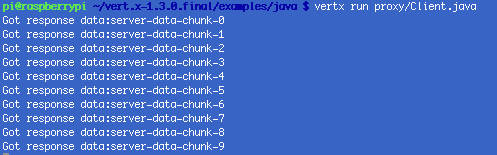
The Proxy example works too, but you need to remember that the Pi isn't an i7 multicore laptop, so just be patient:


For a start, I should Fanout Server works, but again you may need to install a telnet client on your Pi, or run remotely. However, the HTTPS example failed (on Safar, Chrome and Firefox) and I remember this happened in December when I first did this work. I reported the problem to Tim and hopefully we'll get to the bottom of this eventually:


PubSub is another example that often requires a little patience before trying to telnet, but the results are worth it:


The Upload example is relatively simple:


Route Match works too, but remember that the text in the example is wrong and the actual directory is route_match and not routematch!


Make sure you have your CLASSPATH set correctly before running the Resource Load example:

And I think that's it. As I mentioned before, if you have any problems reproducing any of this then let me know and I'm happy to try to help.
Thursday, February 21, 2013
More adventures in Pi land with vert.x
It seems that some people are seeing problems running vert.x on the Pi, so I decided to double check what I did over Christmas. I'm using the exact same configuration as the last time, so it's still the soft float implementation of Wheezy. If people still have difficulties duplicating what I'm seeing here then I'll try again with the hard float version.
So I worked my way through some of the vert.x Java examples only (I'll try the ones I missed at a later date). The thing to realise straight away is that if any of the examples tell you to point a browser, telnet or some other client at a running service then wait a while before doing so: the Pi isn't the speediest device on the block and sometimes it just takes that little bit longer to get going. Try running netstat in a different shell to see what ports have been created and bound as well:


So I worked my way through some of the vert.x Java examples only (I'll try the ones I missed at a later date). The thing to realise straight away is that if any of the examples tell you to point a browser, telnet or some other client at a running service then wait a while before doing so: the Pi isn't the speediest device on the block and sometimes it just takes that little bit longer to get going. Try running netstat in a different shell to see what ports have been created and bound as well:

Starting with EchoServer+Client (you may need to install a telnet client, or just connect from a different machine):

Through HTTP ...


And SendFile ...

SSL of course ...

... and a copy of top output to show the two instances running ...

It wouldn't be a good test of the capabilities of the Pi and vert.x without some WebSockets running, so here's what you should see upon success:

And finally Eventbus Bridge:

There were some failures. HTTPS for instance but I think this is a known problem and will investigate this further before posting anything. However, hopefully this is enough to be getting on with to show that it should be possible to run most (probably all) of the vert.x Java examples on a Raspberry Pi.
Tuesday, February 19, 2013
Move to e-books
Anyone who has known me long enough will know that I love books. Whether it's fiction or fact based, I love the physical medium that books provide. New books have a great smell and crispness about them. Old books often encapsulate their history within their very pages, whether in the form of turned pages, broken spines (something I hate!), stains or something else entirely. And if you return to an old book that you haven't read for years, these imperfections can often stir memories of times past, offering additional value than just reading the text (my copy of To Kill A Mockingbird is just such a book and each time I read it it's like seeing an old friend again.)
Over the years I've collected hundreds of books, ranging from fantasy, science fiction, classics and of course work related. And rarely have I discarded a book. So as I grew up it became harder and harder to get them all out of the boxes in which they often ended up. Then I met my wife who has just as much a passion for books as well as being a collector too. So something had to give.
Several years ago I converted an old HP Jornada to an ebook reader for her and she took to it. The convenience of the form factor, the ability to store hundreds of books on flash memory and the fact that she could get books instantly, sold it to her. I, however, remained unconvinced. The price difference between the physical copy and the electronic copy annoyed me and still does. And I still love the tactile aspect of a real book. Then my wife upgraded to a Sony reader with e-ink and she really fell in love with the format. Though she still buys physical copies of select books, the vast majority of the books she gets today are e-books.
Throughout this I have remained resolutely against moving. As I said, I love the old style format and don't think e-books are the same, no matter how good the technology gets. However, it is the reality of family life coupled with the masses of books we possess that is pushing me towards the electronic versions, at least in a limited way. I'm going to give it a go for selected books: those for which I won't necessarily build emotional ties. But I reserve the right to be disappointed in losing something in the transition and I may go back eventually. Finally, I find it interesting that given my background in computing and adoption of new technologies, I can't get over the hurdle of migrating to e-books. Maybe this is similar to the vinyl versus CD debate of two decades ago?
Monday, February 11, 2013
Nice posting about Colossus and Brian
Brian's been a permanent part of Newcastle University for as long as I can recall, so it's nice to see this write-up on some of the things he's done over the years.
Thursday, February 07, 2013
HPTS 2013 CfP
15th International Workshop on High Performance Transaction Systems (HPTS)
September 22-25, 2013
Asilomar Conference Grounds, Pacific Grove, CA
http://hpts.ws
Every two years, HPTS brings together a lively and opinionated group of participants to discuss and debate the pressing topics that affect today's systems and their design and implementation, especially where scalability is concerned. The workshop includes position paper presentations, panels, moderated discussions, and significant time for casual interaction. And of course beer.
Since its inception in 1985, HPTS has always been about large scale. Over the years the focus has shifted from scalable transaction processing to very large databases to cloud computing. Today, scalability is about big data. What interesting but out-of-the-spotlight big-data applications are out there? How are datacenter software and hardware abstractions evolving to support big data apps? How has big data changed the role of data stewardship‹not just data security, but data provenance and dealing with noisy data? How are big data apps affected by limitations in energy consumption? What advances have occurred in identifying patterns and even approximate schemas at petabyte scale? How have the provisioning of networking, storage and computing in datacenters had to shift to support these apps?
We ask potential participants to submit a brief technical summary or position, presenting a viewpoint on a controversial topic, a summary of lessons learned, experience with a large or unusual system, an innovative mechanism, an enormous problem looming on the horizon, or anything else that convinces the program committee that the participant has something interesting to say. The submission process is purposely lightweight, but we require each submission to have only a single author.
The workshop is by invitation only and is limited to under 100 participants. The submissions drive both the invitation process and the workshop agenda. Participants may be asked to be part of a presentation or discussion session at the workshop. Students are particularly encouraged to submit.
What to submit:
A 1 page position statement or extended abstract
Optional: the written submission can include a link to one or both of the following as an expanded part of the submission:
Maximum of 3 PowerPoint-type slides
Maximum 2 minute video presentation ‹can be of you speaking with or without slides, a video demo or other video illustration of your proposed presentation, etc.
Even if you choose NOT to submit these, the PC may decide to ask you for them later during consideration of submissions.
The length limits will be strictly observed. We won't consider too-long submissions.
How to submit: Go to http://bit.ly/hpts2013submit
When to submit: Now would be good. Official deadlines are:
Submission of Papers: March 11, 2013
Notification of Acceptance: May 24, 2013
HPTS Workshop: September 22-25, 2013
Organizing committee: Pat Helland, Salesforce; Pat Selinger, IBM (General Chair); Shel Finkelstein, SAP; Mark Little, Red Hat
Program committee
Anastasia Ailamaki, EPFL
David Cheriton, Arista Networks/Stanford
Adrian Cockcroft, Netflix
Bill Coughran, Sequoia Capital
Armando Fox, UC Berkeley (Chair)
Sergey Melnik, Google
Adam Messinger, Twitter
Margo Seltzer, Harvard
Wang-Chiew Tan, UC Santa Cruz
Poster session chair
Michael Armbrust, Google
Saturday, January 05, 2013
An update on Pi work
After a few interactions with people on the twitter-verse and writing the blog about building MongoDB for the Pi, I decided that it was probably a good thing to bundle up my distribution of MongoDB for the Raspberry Pi and make it publicly available. So if anyone wants to get it, it's available on github at https://github.com/nmcl/mongo4pi. Enjoy and let me know if you have any issues with it.
Monday, December 31, 2012
Adventures in Pi Land Part Two
In the first part of this blog we looked at the initial setup of the Raspberry Pi. In this one we'll look first at building and running Fuse Fabric, followed by vert.x. So first Fabric and before I go on it's worth mentioning that this is still not complete and I need to check with the team in the new year to figure get more details on the problems, which could very well be due to my setup on the Pi.
Initially we had 256 Meg of swap and with maven2 installed the Fabric build docs tell us to use the m2 profile option (and the right MAVEN_OPTS). Unfortunately the initial build attempt failed with maven2, so I installed maven 3.0.4 which gets us a little further:
[ERROR] Failed to execute goal org.apache.maven.plugins:maven-surefire-plugin:2.12:test (default-test) on project archetype-builder: Error while executing forked tests.; nested exception is java.io.IOException: Cannot run program "/bin/sh" (in directory "/home/pi/fusesource/fuse/tooling/archetype-builder"): java.io.IOException: error=12, Cannot allocate memory -> [Help 1]


Initially we had 256 Meg of swap and with maven2 installed the Fabric build docs tell us to use the m2 profile option (and the right MAVEN_OPTS). Unfortunately the initial build attempt failed with maven2, so I installed maven 3.0.4 which gets us a little further:
[ERROR] Failed to execute goal org.apache.maven.plugins:maven-surefire-plugin:2.12:test (default-test) on project archetype-builder: Error while executing forked tests.; nested exception is java.io.IOException: Cannot run program "/bin/sh" (in directory "/home/pi/fusesource/fuse/tooling/archetype-builder"): java.io.IOException: error=12, Cannot allocate memory -> [Help 1]
So we increase swap to 1024 Meg by again editing the /etc/dphys-swapfile as mentioned before. This helped, but even with these options, the Pi crashed after about 6 hours of building. (Yes, the Pi crashed!) And as you can see from the screen shot, prior to this Java was taking up a lot of the processor time.

And if not Java, then writing to swap:

After playing with more configuration parameters (with failures 6+ hours later) and ordering a faster SD card (which has not turned up at the time of writing), I decided to try the the latest official binary of Fabric from the download site (fuse-fabric-7.0.1.fuse-084) - no point struggling to get it to build if it won't run anyway. Working through the Getting Started tutorial did not produce the expected output, which needs investigation once I get back to work and can talk with the team. For instance, when trying to use camel ...

And over 7 minutes later the same command gave:

And running top showed the processes were fairly idle:

I spent a few more hours trying other options, but nothing really seemed to make a difference or indicate whether the issues were with the Pi or elsewhere. But I still consider this a success, since I learnt a few things more about the capabilities and limitations of the Pi that I hadn't before, as well as about Fabric (which was the original project I had set myself). And I will return to this and see it through the completion soon.
So onwards to vert.x. Initially I decided not to build the latest source, but to just see if the official binary would run. Now vert.x requires JDK 7, so we need to download and that from Oracle. Next, downloading and installing vert.x-1.3.0.final and following the installation guide brings us to:

Success! It took over a minute for the server.js example to initialise (since I'm connecting remotely to the Pi, I changed localhost to the actual IP address). But HelloWorld eventually worked.

We're on a roll here! Next we moved on to the JavaScript Web Application Tutorial - I want to test as much of vert.x as possible and implicitly the Raspberry Pi's boundaries. This tutorial needs MongoDB. Unfortunately you can't just install the Linux distribution version as it's not suitable for the Pi. I looked around to see if there was a build I could get elsewhere and found one, but unfortunately that needs the hardware floating point version of Wheezy, which we can't use if we are using Java 6 or 7.
Someone said that you can build an older version of MongoDB from source which I tried. To do this I made sure we were still working with 1024 Meg of swap. But unfortunately after about 10 hours, the build failed:

Fortunately a little digging around found a couple of other options and I went with the first, i.e., http://mongopi.wordpress.com/2012/11/25/installation/. Still with 1024 Meg of swap, after 12 hours of building and similarly for installation, I ended up with a running version of MongoDB on the Raspberry Pi!

I was then able to progress through the example, but still had a few failures due to incorrect module versions mentioned in the walkthrough. Thanks to Tim for giving the right numbers and he's going to update the pages asap. There are still a few niggles with the example failing during authentication, but I can live with them for now and will get to the bottom of them eventually.
But what about building vert.x from scratch on the Pi? Well that was a lot easier than I had thought given everything else that's happened so far. Building vert.x head from source and getting Jython 2.5.2, we initially get an error:

But if you use the nightly build of gradle:

Which eventually results in ...

Success again!
So what does all of this mean? Well apart from the obvious areas where I still need to see success, I think it's been a great exercise in learning more about the Pi. I've also learnt a lot more about the various projects I wanted to play with this festive season. I'm happy, even if it did take quite a few more days to do than I expected originally!
Adventures in Pi Land Part One
Over this Christmas vacation I set myself a number of pet projects that I'd normally not have time to do during the rest of the year. Over the last 6 months or so I've been playing with the Raspberry Pi, but not really pushing it a lot - more a case of playing around with it. So I decided that I'd try and make all of my projects over Christmas relate to the Pi in one way or another. This blog and the follow up, will relate what happened.
OK, so before we really get going it's worth looking at the Pi setup. In keeping with its background, setting up the Pi is pretty simple and you can find details in a number of places including the official Pi site. But I'll include my configuration here for completeness. First, I've been using one of the original Model B instances, i.e., one with 256 Meg of memory and not the newly updated version with 512 Meg. As a result, if you've got a newer version then you may be able to tweak a few settings, such as the swap space.
Because I'm playing with JDK 6 and 7, I used the soft-float variant of Wheezy. After burning that to an SD card, remember to use rasp-config to get back the entire disk space, or you'll find an 8Gig SD card only appears to have a few hundred Meg free! And don't forget to use the right kind of SD card - faster is better. I run my Pi headless (no free monitor or keyboard these days), so initially I had it connected to my router via an ethernet cable and then immediately configured wifi. How you do this will depend upon the wifi adapter you use, but I'm happy with the Edimax EW-7811Un and you can get information about how to update the kernel with the right driver from a number of places.
Once wifi was up and going, I changed swap size for the Pi. In the past this wasn't an issue, but then I hadn't been about to build Arjuna, Fuse, vert.x and MongoDb! You can modify swap by editing /etc/dphys-swapfile and then running /etc/init.d/dphys-swapfile stop followed by /etc/init.d/dphys-swapfile start. Initially I started off with 256 Meg of swap, but as you'll see later, this wasn't always sufficient! Finally let's start by adding openjdk 6 (sudo apt-get install openjdk-6-jre openjdk-6-jdk) followed by git and maven (sudo apt-get install maven2 git).
So this brings us to a base from which we can proceed with the real projects. The first one, which was building Arjuna/JBossTS/Narayana, was pretty straightforward compared to the others and has been documented elsewhere. Which means in the next instalment we'll look Fuse Fabric, vert.x and because of that project, MongoDB.
OK, so before we really get going it's worth looking at the Pi setup. In keeping with its background, setting up the Pi is pretty simple and you can find details in a number of places including the official Pi site. But I'll include my configuration here for completeness. First, I've been using one of the original Model B instances, i.e., one with 256 Meg of memory and not the newly updated version with 512 Meg. As a result, if you've got a newer version then you may be able to tweak a few settings, such as the swap space.
Because I'm playing with JDK 6 and 7, I used the soft-float variant of Wheezy. After burning that to an SD card, remember to use rasp-config to get back the entire disk space, or you'll find an 8Gig SD card only appears to have a few hundred Meg free! And don't forget to use the right kind of SD card - faster is better. I run my Pi headless (no free monitor or keyboard these days), so initially I had it connected to my router via an ethernet cable and then immediately configured wifi. How you do this will depend upon the wifi adapter you use, but I'm happy with the Edimax EW-7811Un and you can get information about how to update the kernel with the right driver from a number of places.
Once wifi was up and going, I changed swap size for the Pi. In the past this wasn't an issue, but then I hadn't been about to build Arjuna, Fuse, vert.x and MongoDb! You can modify swap by editing /etc/dphys-swapfile and then running /etc/init.d/dphys-swapfile stop followed by /etc/init.d/dphys-swapfile start. Initially I started off with 256 Meg of swap, but as you'll see later, this wasn't always sufficient! Finally let's start by adding openjdk 6 (sudo apt-get install openjdk-6-jre openjdk-6-jdk) followed by git and maven (sudo apt-get install maven2 git).
So this brings us to a base from which we can proceed with the real projects. The first one, which was building Arjuna/JBossTS/Narayana, was pretty straightforward compared to the others and has been documented elsewhere. Which means in the next instalment we'll look Fuse Fabric, vert.x and because of that project, MongoDB.
Wednesday, December 26, 2012
Thunderbirds are go!
Over the year a number of people who were influential in my life have died. So it's with great sadness that I just heard that Gerry Andersen passed away today! Growing up in the later 60's and early 70's, programs such as Space 1999, Thunderbirds, Joe 90, Stingray and Captain Scarlet were the height of TV watching for kids. Each episode was an event, probably on the same scale as blockbuster films are today for kids. Having two children growing up over the past 2 decades, I can say that I've had to watch quite a lot of children's TV in the 90's and beyond, and yet none of them seem to have been as influential on my kids or their friends as Gerry Andersen's various efforts had on us.
Some kids watching them today may laugh at the special effects or the "wooden" acting, but I think that's due to the expectations that films like Lord of the Rings or Avatar have set. But relatively speaking, Gerry was the king of his era and those programs will live on in the memories of many people, myself included. It's truly a sad day. And I can't think of a more fitting way to say thank you and honour that memory than to watch my boxset of Stingray!
Some kids watching them today may laugh at the special effects or the "wooden" acting, but I think that's due to the expectations that films like Lord of the Rings or Avatar have set. But relatively speaking, Gerry was the king of his era and those programs will live on in the memories of many people, myself included. It's truly a sad day. And I can't think of a more fitting way to say thank you and honour that memory than to watch my boxset of Stingray!
Subscribe to:
Posts (Atom)